Ads 468x60px

About Me


Darren Winters is a self made investment multi-millionaire and successful entrepreneur. Amongst
his many businesses he owns the number 1 investment training company in the UK and Europe.
This company provides training courses in stock market, forex and property investing and since
the year 2000 has successfully trained over 250,000 people.


Showing posts with label india. Show all posts

Thursday, 12 June 2014

The New Investor Friendly India

Earlier this week the president of India, Mr. Pranab Mukherjee, addressed the Indian Parliament. This was on the occasion of the first sitting of parliament following the elections that brought the new Prime Minister Narendra Modi to power with a landslide victory. The emphasis of  the presidential speech was on economic reform and a return to double digit growth, something that has been lacking in the last two years, which have seen less than 5% growth apiece. According to Mukherjee, putting the economy back on track is of paramount importance. 


How will this be achieved? Through initiatives like the introduction of a goods and service tax, encouragement of foreign direct investment, making the tax regime more business friendly, controlling inflation, and investing in infrastructure, just for starters. The infrastructure promise includes the pledge that by 2022 every family will have a good home with a constant electricity supply. The railway will be upgraded, and new roads and airports will be built.


Investment, both domestic and foreign, will lead to job creation. With 10 million people entering the workforce every year, that will be music to the ears of so many of the younger voters who wanted an end to the rule of the Congress Party. After being in power for 55 of the last 67 years, and most recently for a continuous 10 year period, the Congress Party is perceived as being responsible for the recent poor economic performance, in spite of almost double digit growth in four of those years. It is also seen as a party riven with corruption.

Controlling inflation is seen as high priority. Consumer Price Inflation hit a high of almost 9% in April, due mostly to higher food prices. The volatility of food prices has been linked to a poor supply chain – namely warehouse shortages, food hoarding and black market activity, unpredictable supplies of vegetables, and the generally weak infrastructure. These ‘bottlenecks’ will be addressed by the new government. Meanwhile, in an effort to contain inflation the Reserve Bank of India has raised interest rates three times since last September.


The coal sector will be one of the first industries to be targeted in a drive to improve efficiency and output in a ‘transparent’ way. Corruption and bureaucracy have seen mining output decrease, and India is a large importer of coal even though it has plenty of it available at home. One suggested plan is to break up the state owned Coal India company into smaller independent units, and also to open up the sector to private investment, including foreign investment. Coal is a cheap and potentially plentiful form of energy from India’s perspective, so improving the efficiency of its production is an urgent task.

India is also expected to lift restrictions currently limiting online retailers like Amazon from selling their own products in the country. Freeing up the ecommerce space is predicted to boost a contribution of 4% to economic growth by 2020, as opposed to 1% at the moment. Opening up the economy to online giants like Amazon is expected to benefit local manufacturers and suppliers as they form partnerships with Amazon and others to source cheaper local products. The decision to press ahead with this more liberal approach may well be announced in the first budget of the new government in July.

Another area for improving the ratio of foreign direct investment is in companies in the defence sector, where figures of up to 100% have been quoted. In the last ten years foreign investment has accounted for only $5billion of a $322 billion dollar overall investment in the sector. Private Indian companies have only been permitted to operate in the defence arena since 2002. Although the need for investment exists, there is some resistance to allowing such a high level of participation by foreign investors. If they are to be allowed to invest it should be conditional on a transfer of technology to India and training of Indian employees, said a source from Larsen and Toubro, a large Indian private defence contractor.

It is one thing to talk a good reform package, but can Mr. Modi deliver? He was credited with  great success as Chief Minister of Gujarat, where under his stewardship the economy grew and the state prospered. He even saw to it that the state had electricity 24 hours a day. Whether he can apply that golden touch to the economy of India as a whole remains to be seen. His image is one of a man who is corruption free, which no doubt helped him get re-elected as Chief Minister of Gujarat three times.

Responding to the president’s speech on Wednesday, Mr. Modi said "It is the collective responsibility of all elected representatives to fulfil the faith reposed in us by the electorate. I reassure the house that all the promises made in the President's speech will be delivered." He went into detail, citing enhancement of agricultural productivity as one step on the path, and encouraging the wider use of organic farming methods in the whole of the North East of the country, with the aim of entering the global market in organic produce.

Elimination of poverty will be reduced through more educational opportunities and the lowering of food prices. Even currently skilled workers should be given more chances to improve their marketability through further education. This also leads to improved social status, and the improvement of the social infrastructure in India is another important factor in the resurgence of the country. Mr. Modi admitted that the Gujarat model could not be applied across India, saying that “Different states offer different lessons and we plan to implement the best examples.”

The new government is in the honeymoon phase, and euphoria is high. There can be no underestimating the challenge facing Mr. Modi though as he begins his reformation. The mood has been optimistic and was certainly reflected in a surge in the stock markets once the election results were almost certain. Mr. Modi’s first budget in July should give a clearer indication of just how he intends to begin the great Indian comeback, and also give a clue as to just how investor friendly India might turn out to be. 

Thursday, 29 May 2014

Emerging Markets - Major Markets


By definition an emerging market economy is one that has a low to middle per capita income which is in the process of moving from a closed economy to an open market economy. They currently represent approximately 20% of global economies. Although China is considered to be one of the largest economies of the world it is still classified as an emerging market due to its developments and reforms and low capita income per head. In general, emerging markets are deemed to be fast-growing economies into which developed economies look for new sources of income, and through their investment the emerging economy’s production levels rise thus increasing their GDP.

The four largest emerging economies are Brazil, Russia, India and China, often abbreviated to the BRICs and the next four largest are Mexico, Indonesia, South Korea and Turkey. More recently, focus has fallen on Mexico, Indonesia, Nigeria and Turkey, now known as the MINT economies as the four emerging economies with the most promise.

Emerging market economies experienced a challenging end to 2013 as the interest rates of developed economies reached rock bottom, commodity prices eased, demand from China slowed and the Federal Reserve Bank in America commenced the tapering of quantitative easing. Fear grew that increasing interest rates in the developed economies would result in negative returns in emerging market economies.
In January 2014 the IMF predicted growth of 5.1% in 2014 and 5.4% in 2015 for emerging and developing economies compared with growth of only 2.2% in 2014 and 2.3% in 2015 for advanced economies.

It would be dangerous to treat all emerging economies the same and this is reflected in the various economic figures, as estimated by the IMF, and it is difficult to predict which sectors or countries will do best.

The IMF are currently predicting GDP of 1.8% in 2014 and 2.6% for 2015 for Brazil and inflation of 5.9% in 2014 falling to 5.5% in 2015 whilst unemployment is forecast to rise from 5.3% in 2014 to 5.8% in 2015. For Russia the figures are GDP of 1.3% in 2014 and 2.3% in 2015 together with inflation of 5.7% in 2014 falling to 5.3% in 2015 whilst unemployment is forecast to hold steady at 6.2% for both years. For India, GDP of 5.4% in 2014 and 6.3% in 2015 with inflation of 7.9% in 2014 falling to 7.5% in 2015. They do not have any unemployment rates for India. For China, the GDP figure is 7.5% in 2014 and 7.2% in 2015 with inflation of 3% in both 2014 and 2015 whilst unemployment is forecast to hold steady at 4.1%.

The MINT economies of Mexico Indonesia and Turkey all have stable inflation and public finances whilst Mexico, Nigeria and Indonesia are in the G20 bloc of developing nations.
Tapering will result in a fall in global dollar liquidity which could damage those emerging market economies who are heavily reliant on external financing of their current account deficits or those with domestic weaknesses. This could result in an outflow of foreign capital in the short term which would push their exchange rates lower and in turn lower the inflationary expectations. This would subsequently reduce economic activity and could result in a need to raise interest rates to maintain currency levels, thus causing domestic growth to stall. The countries most at risk of this are the “fragile five” of Brazil, South Africa, India, Turkey and Indonesia.


Fears of a slow-down in China has also put pressure on emerging market economies. Recent Chinese PMI data has shown that the economy there continues to contract, albeit at a slower rate. However, based on the average figure over the first quarter there is evidence of a small rise which could mean the GDP growth might improve in the second quarter from its recent low of 7.4%. There have been signs of an increase in both output and new orders, and in particular export orders, since the beginning of the year. The improving economic conditions in the overseas markets of the US, the UK, Europe and Japan should be feeding through to China’s export figures. Another sign of this pick up is the reduction in inventories of finished goods in China and an increase in the purchasing of raw materials.
Global growth in April was at its slowest rate since last October hindered by the sluggish rate of growth in the emerging market economies. The HSBC Emerging Markets Index, a weighted composite indicator from national HSBC Purchasing Managers’ Index showed that emerging market output growth remained weak in April recording only a marginal increase from 50.3 to 50.4, which is far short of its 8.5 year long run trend of 53.9. Both the manufacturing and services PMIs of the emerging markets were sluggish. 

The BRIC emerging economies all came in below 50. The most marked fall being in Russia where the PMI figure was the lowest recorded since May 2009. Business activity in India fell for the 9th time in 10 months but there are hopes of a recovery following the recent general election results.

In the global table of manufacturing PMIs, the Czech Republic, came in second to the UK, ahead of Ireland, the US and Germany. Brazil, Russia and China were all below 50 whilst India managed to climb above 51. The only other country to record below 50 was Japan although this could be a temporary situation attributable to a sales tax hike in the country. Japan had seen strong growth in previous months as consumers brought forward their spending ahead of the tax increase on the 1st April so it is likely that this will only have temporary impact.
Seven of the countries to record a PMI figure below the global average of 52 came from the emerging markets. These were Mexico, India, Indonesia, Turkey, South Korea, Singapore and Indonesia, whilst there was better growth in Vietnam and Taiwan.
For long term investors emerging market economies should continue to produce good returns despite the recent setbacks, however further volatility can be expected. Many of the countries have large young populations who aspire to Western standards of living. This will require huge investment from governments and structural reforms but should drive growth in these areas for decades. 

Darren Winters

Tuesday, 20 May 2014

Modi Wins - will India Prosper?

It’s no surprise that when the world’s largest democracy, India with a population of 1.2 billion people and economy valued at 4.962 trillion dollars, based on 2013 GDP figures, goes to the polls the world’s media sits up and pays close attention.   
Whilst the outcome of the recent national elections in Indian was fairly predictable, based on local polls, which pointed to a land slide victory for the former tea merchant, Narendra Modi's Bharatiya Janata Party (BJP), nevertheless, the election would be a momentous occasion for the emerging economy, India. No other political party other than the Congress party had ruled the country for 18 of the 67 years, since its independence from Britain. The elections were a "genuinely revolutionary moment … a democratic asteroid," according to author and academic Sunil Khilnani, as reported in the Times of India.


Indeed, Modi's politically right leaning BJP party now controls around 340 of the 543 elected seats in parliament at the cost of the centre-left who had their representation squashed to just 40 seats, a historic low.  With voter turnout at around 66.38 percent, up 3 percent in the 1984-85 elections, according to Hindustan Times, it becomes apparent that Modi BJP leading party has conceded power with a healthy legitimacy of its people. Moreover, the Indians have given their thumbs up to a pro business party and they appear to have shunned the political left.

Meanwhile, the herd instinct of the financial market has driven the Indian stock market to record highs and the local currency, the rupee has rallied since Modi’s election win.
Therefore, with all this in mind, a politically friendly business climate and buoyant Indian financial markets, a question worth pondering over is whether all this might be a catalyst for greater capital inflows to India. 

Modi undoubtedly is keen on attracting inward investment to India, bearing in mind that capital investment accounts for nearly 35 percent to India's economy, which incidentally barely grew in the previous fiscal year that ended in March due to funding issues, thereby putting a spanner in the works of many infrastructure projects.
There are some pressing issues for Modi to deal with as soon as he puts his feet under the premier’s desk. For example, on the economic front India’s credit rating has been downgraded to a "BBB-minus", by the credit rating agency Standard & Poor, which has a negative outlook on its sovereign debt.  The market is now anxiously waiting to see if Modi can prevent a further downgrade by the credit rating agency to junk status. The pivotal point will be in July when the new government will need to convince investors that it is serious about getting its budget deficit under control

But getting the deficit down to its target of 4.6 percent of gross domestic product (GDP) is by no means an easy feat.  The previous administration, riddled with corruption scandals, has not left the state coffers in a healthy state. Moreover, the Indian economy is neither looking virile and relatively reliant on public funding. Public spending in the Indian economy accounts for 11 percent of GDP. So a cut in government spending could be a further dampener on the Indian economy as a sizable number of the electorates’ livelihoods are dependent, either directly or indirectly, on it.  Austerity is not going to be an easy sell for the Modi, despite the leader’s landslide victory.
Also improving the state’s coffers from increased tax revenues is unlikely to materialize in a relatively fragile economy.
Moreover, India’s Reserve Bank is keen on tackling the inflation rate, which currently stands at 8.6 percent. Their inflation target is 7 per cent by January 2016.  The implication here could be further interest rate hikes; already it has jacked up interest rates three times since last September.  But higher interest rates could be a double blow for India’s businesses by increasing the cost of financing and servicing existing debt, but also it would appreciate
 the rupee and make exports more expensive.

Then there are all these bad loans racked up, 100 billion USD to be precise, which are mainly associated with public infrastructure projects.  This currently represents 10 percent of all loans and it is estimated to reach 14 percent of loans by March 2015, according to Fitch Ratings.

The trade deficit is another issue the new government may need to get to grips with.  Indian has set a target of a 2 percent trade deficient of its GDP. Gold imports have contributed to a greater than desired trade deficit. The previous administration responded by slapping tariffs, duties onto gold, which then fuelled a black market in the precious metal.  Modi has promised to abolish these duties on gold. While this may be good news for gold buyers, this could also exert downward pressure on the value of the rupee, which would not be favorable to investors.  

Another potential black swan for investors could be the ongoing religious feud between the Hindu majority and the Muslim minority.  Modi, a Hindu, may not be perceived by the alienated and in some cases discriminated Muslim population, representing 14 percent to be sympathetic towards Muslim issues.  Many Indian Muslim distrust Modi, who has been allegedly linked with a police assassination squad, which targeted Muslims. If the Muslim minority population continues to feel alienated, they could be radicalized resulting in more attacks against western interests.

There are some clear distinctions between China and India’s economy. For one, China has a large trade surplus, whilst the later has a deficit. China’s GDP grow rate, albeit decelerating in growth, at 7.7 GDP in 2013. India’s GDP growth rate has been estimated at 4.7 percent. China’s population is ageing, India’s is relative young and maybe looking into the future confident and energized by their new leader, while China’s people continue to be repressed by the regime, cohurst into accepting inhumane working conditions. The protests continue in China-how long can the authorities repress a nation of 1.3 billion people. 

Darren Winters

Friday, 16 May 2014

The Rise of Emerging Markets


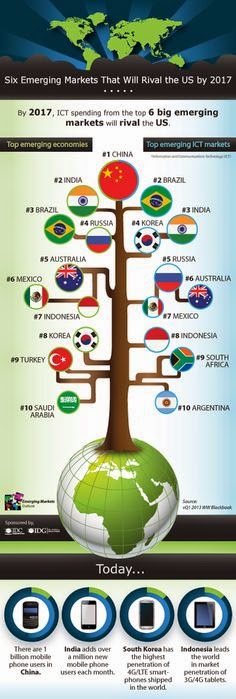
With the Chinese economy on the verge of overtaking America's, the importance of emerging markets, and the changing world order their emergence will create, comes more sharply into focus. As emerging market countries grow their GDP they present investors with opportunities to take advantage of that growth.  

But what exactly defines an emerging market? The term was first used by economists in the 1980's to describe developing economies. A country that's developing has characteristics that include movement towards a free market model, an increasing population of young people, an increasingly sophisticated infrastructure, more political stability (democracy as opposed to dictatorship), and a healthy level of foreign investment.

The four major emerging countries are Brazil, Russia, India and China - known in financial slang as the BRICs. The acronym was first used by Goldman Sachs in a 2003 report. Their belief at the time was that by 2050 these four countries would become wealthier than the current dominant economic powers. The BRICs are followed by the 'Next Eleven', namely Bangladesh, Egypt, Indonesia, Iran, Mexico, Nigeria, Pakistan, Philippines, South Korea, Turkey and Vietnam.

It's worth reflecting for a moment on where we are now in terms of economic supremacy. Western economic dominance came about as a result of the Industrial Revolution, when the means to accelerate production raised output and helped propel  America to where it is today. Before the Industrial Revolution, population tended to be the determining factor in economic performance. What we're seeing now, amply demonstrated by China, is an exercise in industrial catch up. Combine this with an increasingly affluent population of 1.3 billion, which pushes up GDP, and you have the makings of a new economic superpower.

The interesting thing from a potential investor's point of view is that emerging markets are predicted to grow up to 3 times faster than America, according to the International Monetary Fund. Which offers the prospect of good returns. So what are some good solid reasons for including emerging markets in your portfolio?

Diversification: - emerging market countries don't mirror the performance of developed countries, which means they aren't subject to the same downturns. They will have downturns of their own periodically though, so they'll need monitoring.

Predicted growth prospects: - it's estimated that about 70% of global economic growth will come from emerging markets in the near future. India and China are predicted to supply 40% of that growth.

Surplus cash: - most emerging markets have a much better current account surplus than developing economies overall, with China predicted to have a surplus of $450 billion by 2016, as opposed to America's deficit of $643 billion.

Young people: - The workforces of Brazil and India have a high ratio of young people to those retired, which means there'll be plenty of young people supporting the state benefits of their elders. America and the UK by contrast have aging populations, which puts a strain on the welfare system.

Long term performance: - according to Morgan Stanley, who have a number of emerging market indexes, emerging markets have outperformed the developed markets for the last 15 years, a trend that should only continue.

Higher spend: - Consumers in the emerging markets are increasing their disposable incomes and therefore spending more money. The middle class is getting richer. Chinese consumers are prime spenders on luxury goods.

Technology sector: - Social networking is extremely popular in China, with sites like Weibo boasting 130 million active users. There's also Alibaba, which is flourishing and planning an IPO soon. It's the world's largest online marketplace. Russia has search engine Yandex, which now trades on the New York Stock Exchange. These are all money makers.


There are some compelling reasons to feel confident about the continued growth prospects in BRICs and other emerging market countries. Of course this speed of growth brings its own risks, and the amount of exposure to emerging markets in your portfolio should reflect this. Advisers recommend between 5% to 10%.

So, what is the state of, and immediate prospects for the BRICs in May 2014?

Brazil: - will be hosting the world cup this year and the Olympics in 2016, which means it's very busy building the infrastructure to support these. Unemployment rates are low as a resut. However, the forecast for this year sees Brazil's economy slowing, and inflation rising.  Growth is predicted to rise only 2.3%. There have been street protests over the use of public money recently, and President Dilma Roussef is not enjoying a lot of popularity. With some work to do, it seems Brazil won't be contributing greatly to world economic growth this year.

Russia: - the Ukraine crisis and the subsequent sanctions are hurting the Russian economy. The stockmarket and the Rouble have both fallen, and investors have taken around $60 billion out of the country in the last 3 months. In its favour it has plenty of income from gas and oil, and is running a current account surplus. But growth has slowed in the last 18 months, and Russia needs foreign investment, which it isn't getting. If sanctions start to bite things can only get worse. Its poor performance has led some experts to question whether it should be dropped from the BRICs.

India: - the rate of growth in India was down to just under 5% last quarter, down from the high of 9.3% in 2010. The prospects for renewed growth are positive, but a lot will depend on the results of the current election. If Narendra Modi emerges as the victor he is expected to make growth a priority. Economists are expressing optimism for the longer term.

China: - Growth is forecast to continue at about 7.5% this year. This represents a slowdown in recent years, but the government is reportedly happy to go at a slower pace while it introduces reforms like the abolition of the one child policy, and providing better healthcare and affordable housing. The Boston Consulting Group (a leading consultancy) is very bullish on China, and predicts steady growth going forward.

A bit of a mixed report then. Brazil and Russia not looking so healthy, but India and China with cause to be optimistic. It seems that some research is in order before taking the plunge into an emerging markets product. The road to those potentially higher returns could have some volatile ups and downs, but it's a market sector that can't be ignored.

Darren Winters

Wednesday, 14 May 2014

The USA is still number one and China is so yesterday!!?? Why?


The World Bank made eye catching headlines last week when it stated that China may overtake the USA as the world’s biggest economy as early as this year. Apparently, China is hot on the heels of the USA’s 125 years of global economic dominance; moreover this is occurring faster than anticipated, according to the World Bank’s International Comparisons Program (ICP). Indeed, back in 2005, the number crunchers at the ICP estimated that China’s economy was about 43 percent the size of the USA.  But their latest report, based on 2011 data, reckons China’s economy to be valued at $13.5 trillion, which amounts to 87 percent of the US economy, which is $15.5 trillion.   


Moreover, the dragon was given more puff just one week after the ICP report when it was also reported in the Forbes 2000 list that three of the biggest public companies and five of the top ten world’s largest companies are Chinese: Commercial Bank of China, China Construction Bank and Agricultural Bank of China to name but a few.

At this point it is also worth noting that China already held this top position of the world’s biggest economy during the Qing dynasty (1644-1911), prior the US industrial revolution.
So this time around should we all pack up sticks, sell dollars, buy yen and move east in search of the dragon?
Not really, you see while the claim of rising dominance of China and possible global economic dominance of China by as early as next year may have made headline grabbing news, it might have been also over played.

To understand why this may be so we need to determine what economic data is used to measure and compare economies.
Take, for example, Gross Domestic Product (GDP), which is the monetary value of all the goods and serviced produced within a country’s territory within a specified period (normally a year). GDP figure includes the sum of all private consumption (C) plus the sum of government spending (G), the sum of all business investment (I) and the nation’s net exports (NX), which equates to exports minus imports. So GDP=C+G+I+NX.


But if we use GDP alone to compare the prosperity of a country’s economy with another, it may be misleading because the figure doesn’t factor in the population size of the country.  Take for example, two extremes like India with a $1.758 trillion GDP estimated figure in 2013 and Norway’s GDP of $515.8 billion in the same year. According to GDP figures India is a far bigger economy; nevertheless the Norwegians are far more prosperous than the Indians. In this line of reasoning China’s GDP may have led the world in the 19th century due to its sheer population numbers, nevertheless China back then was also a relatively isolated backward place and in a desperate state.

So if we measure China’s economy in terms of per capita GDP, then we get another picture. The GDP per capita is calculated by taking the GDP figure divided by the number of people. China’s GDP per capita ranks only 99 in the world, behind that of Peru. Using this figure we can determine that China is still relatively poor.

However, fluctuating exchange rates makes cross border comparisons a dicey business. Purchase Power Parity (PPP) needs to be factored into the equation when making comparisons.   The PPP calculates the amount of adjustment needed on the exchange rate between countries in order for the exchange to be equivalent to each currency's purchasing power. It can be calculated by dividing the costs of goods x in country 1 (P1) divided by the costs of goods x in country 2 (P2). Thus, S=P1/P2 where (S) represents the exchange rate of country 1 to country 2.  

But even when you play around with all the figures to try and gauge comparisons one has to ask just how accurate are these economic indicators coming out of China. China's National Bureau of Statistics has been accused of fudging the figures by double counting various economic activities, such as factory production, according to numerous economists.


Perhaps we need some other indicator to determine whether China will topple the USA in economic might.  After all it is a country’s ability to innovate, create, develop and market new technologies, products, services more of an indicator of a country’s economic might in the world. To what extent has China’s mammoth growth over the previous decade been down to the innovation and creativity of its people? Being the world’s factory, offering low labor costs and having the technology and creative aspects conducted outside your borders is not a model for world dominance. Moreover, in China’s repressive model of economic capitalism where speaking out against the regime can cost you your freedom, this doesn’t liberate free minds to challenge the status quo, to think outside the box, to innovate, to create. It would be a mistake to underestimate the intelligence of the Chinese; they are an ancient civilization, great strategic thinkers. But under repression minds are shackled and creative thinking is stifled.   

The USA’s ideals of freedom, tolerance, acceptance, rewarding success and even admiring it, are universal ideals that are seductive for talented young minds from Beijing to Bombay to Oslo. Critics may call it spin, an illusion, maybe even a Hollywood plot, nevertheless, if these ideals continue pulling in young talent from across the globe it just may keep the USA in first place. “In God we trust,” is written on all US notes, maybe it’s the people that they trust more in.  

Darren Winters
 
Blogger Templates