Ads 468x60px

About Me


Darren Winters is a self made investment multi-millionaire and successful entrepreneur. Amongst
his many businesses he owns the number 1 investment training company in the UK and Europe.
This company provides training courses in stock market, forex and property investing and since
the year 2000 has successfully trained over 250,000 people.


Showing posts with label IPO. Show all posts

Wednesday, 11 June 2014

TSB's IPO

There’s another bonanza on the horizon but the only snag is that you have got to be pretty much a high roller to cruise this one all the way to the bank. Joe public, that’s me, can only watch with glee and perhaps pickup some crumbs later. This is all with reference to the Initial Public Offering (IPO) of TSB shares, the prospectus and price of which was published by Lloyds today.                    

Indeed, the tune sounds familiar; it starts typically with a bank, a financial crisis of 2008, then the bank goes cap in hand to the government for a chunk of money claiming it desperately needs it to keep afloat. So the bank gets nationalized, on the tax payers’ expense. Finally, there is an IPO, or a stock market launch where the shares are sold to the general public on the stock exchange.
But the Holy Grail is obtained when investors get in early at the offer price, which is the price before the shares start trading on the stock market. Quite literally vast fortunes can be made, over night, or in one trading day, for those investors who are able to buy in at this early stage, before the shares are traded on the market and available to the public.  The offer price, set typically just a few days before the IPO date, is the price paid by the big players, the institutional investors who commit to buy the shares at the offer price before the IPO. Trying to get in early at the offer price is like trying to gain access to Annabel’s, London most exclusive members only club. You need to be already high up the food chain. The stockbrokers, who are responsible for placing these shares, gauge with their best clients, usually investment banks, perhaps even a syndicate of investment banks, or extremely well heeled individuals, their interest in the shares at the potential offer price. This price in theory is determined by analysts who assess the business’s financial accounts to determine what the business is worth.

Where things tend to get skewed is when there is a revolving door, a movement of personnel between roles of politics and financial institution and regulator to benefit this exclusive closed circle of powerful and privileged individuals to the public’s detriment.
Take for example the pending public offering of TSB, which is worth 1.6 billion USD according to its net asset value (the value of the company’s assets minus its liabilities).  The bank already has 4.5 million customers and 6 percent of bank branches in the UK, making it Britain's seventh-largest retail bank in the country.  Yesterday morning Lloyds announced in a statement that it would set the price range for the TSB IPO at between 220p and 290p. That would give TSB a market capitalization (market share value multiplied by the number of shares in issue) of approximately £1.28 billion at the mid-point at the proposed offering. That would be £320,000,000 million below TSB’s book value, or net asset value (using the midpoint value).
So it becomes fairly apparent for all of us to understand that buying in at the offer price, before the shares start trading on the stock market usually means rich pickings for those investors in just a tremendously small amount of time. Put simply, these investors are fortunate enough to purchase an asset at well below its true value and then extract the surplus profits by selling out on the first day when the shares commence trading on the stock market. This is akin to buying a house below its market value, then flipping it to make a quick profit.

Admittedly, there is some element of risk when investors buy in at the offer price because they have agreed to purchase a large chunk of the shares at a pre determined price before they start trading on the stock market. Assuming that there is little or no public interest in the TSB public offering, then according to the simple laws of supply and demand the shares could fall to a level below the offer price. In theory that could leave the underwriters of TSB, particularly the main underwriters, with large losses on their hands.
This is somewhat the argument that city analysts have cited for undervaluing the TSB offer price, according to reports in the Times.  Apparently, there has been a deterioration in appetite for UK flotations in the second quarter of 2014. One unnamed source told The Telegraph that the TSB IPO was priced ‘to go’ with the range based on pre-road show conversations with investors from the UK, the US and Asia. Moreover, the TSB IPO has apparently already attracted significant demand from retail investors due to the banks simplistic and transparent business model, according to reports in the Telegraph. Furthermore, the share bonus scheme which enables retail investors to get one free share for every 20 shares they have purchased, but the only snag is that they have got to hold on to the shares for a period of one year after the floatation.

Therefore, with the TSB’s offer price valued well below the business’s value and apparent strong demand from retail investors, it stands to reasoning that the underwriters are likely to make huge profits on this one when the shares start trading in late June, albeit at the expense of the taxpaying public.
Joe public might also be able to pick some of the spoils, if this apparent strong demand actually materializes when the shares commence trading, but they will need to do so early through an intermediary, such as a stockbroker.  Lloyds will be announcing the final price for the TSB float on or around June 20, which will also be the date for conditional dealings on the London stock market  (the point when you may be able to trade via your broker).

Friday, 16 May 2014

The Rise of Emerging Markets


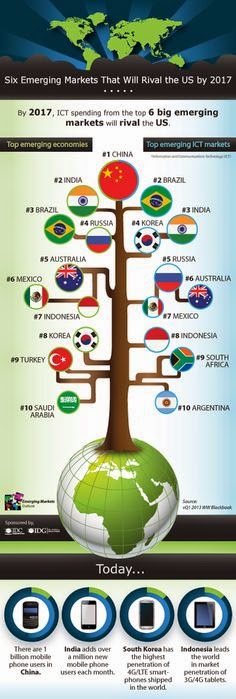
With the Chinese economy on the verge of overtaking America's, the importance of emerging markets, and the changing world order their emergence will create, comes more sharply into focus. As emerging market countries grow their GDP they present investors with opportunities to take advantage of that growth.  

But what exactly defines an emerging market? The term was first used by economists in the 1980's to describe developing economies. A country that's developing has characteristics that include movement towards a free market model, an increasing population of young people, an increasingly sophisticated infrastructure, more political stability (democracy as opposed to dictatorship), and a healthy level of foreign investment.

The four major emerging countries are Brazil, Russia, India and China - known in financial slang as the BRICs. The acronym was first used by Goldman Sachs in a 2003 report. Their belief at the time was that by 2050 these four countries would become wealthier than the current dominant economic powers. The BRICs are followed by the 'Next Eleven', namely Bangladesh, Egypt, Indonesia, Iran, Mexico, Nigeria, Pakistan, Philippines, South Korea, Turkey and Vietnam.

It's worth reflecting for a moment on where we are now in terms of economic supremacy. Western economic dominance came about as a result of the Industrial Revolution, when the means to accelerate production raised output and helped propel  America to where it is today. Before the Industrial Revolution, population tended to be the determining factor in economic performance. What we're seeing now, amply demonstrated by China, is an exercise in industrial catch up. Combine this with an increasingly affluent population of 1.3 billion, which pushes up GDP, and you have the makings of a new economic superpower.

The interesting thing from a potential investor's point of view is that emerging markets are predicted to grow up to 3 times faster than America, according to the International Monetary Fund. Which offers the prospect of good returns. So what are some good solid reasons for including emerging markets in your portfolio?

Diversification: - emerging market countries don't mirror the performance of developed countries, which means they aren't subject to the same downturns. They will have downturns of their own periodically though, so they'll need monitoring.

Predicted growth prospects: - it's estimated that about 70% of global economic growth will come from emerging markets in the near future. India and China are predicted to supply 40% of that growth.

Surplus cash: - most emerging markets have a much better current account surplus than developing economies overall, with China predicted to have a surplus of $450 billion by 2016, as opposed to America's deficit of $643 billion.

Young people: - The workforces of Brazil and India have a high ratio of young people to those retired, which means there'll be plenty of young people supporting the state benefits of their elders. America and the UK by contrast have aging populations, which puts a strain on the welfare system.

Long term performance: - according to Morgan Stanley, who have a number of emerging market indexes, emerging markets have outperformed the developed markets for the last 15 years, a trend that should only continue.

Higher spend: - Consumers in the emerging markets are increasing their disposable incomes and therefore spending more money. The middle class is getting richer. Chinese consumers are prime spenders on luxury goods.

Technology sector: - Social networking is extremely popular in China, with sites like Weibo boasting 130 million active users. There's also Alibaba, which is flourishing and planning an IPO soon. It's the world's largest online marketplace. Russia has search engine Yandex, which now trades on the New York Stock Exchange. These are all money makers.


There are some compelling reasons to feel confident about the continued growth prospects in BRICs and other emerging market countries. Of course this speed of growth brings its own risks, and the amount of exposure to emerging markets in your portfolio should reflect this. Advisers recommend between 5% to 10%.

So, what is the state of, and immediate prospects for the BRICs in May 2014?

Brazil: - will be hosting the world cup this year and the Olympics in 2016, which means it's very busy building the infrastructure to support these. Unemployment rates are low as a resut. However, the forecast for this year sees Brazil's economy slowing, and inflation rising.  Growth is predicted to rise only 2.3%. There have been street protests over the use of public money recently, and President Dilma Roussef is not enjoying a lot of popularity. With some work to do, it seems Brazil won't be contributing greatly to world economic growth this year.

Russia: - the Ukraine crisis and the subsequent sanctions are hurting the Russian economy. The stockmarket and the Rouble have both fallen, and investors have taken around $60 billion out of the country in the last 3 months. In its favour it has plenty of income from gas and oil, and is running a current account surplus. But growth has slowed in the last 18 months, and Russia needs foreign investment, which it isn't getting. If sanctions start to bite things can only get worse. Its poor performance has led some experts to question whether it should be dropped from the BRICs.

India: - the rate of growth in India was down to just under 5% last quarter, down from the high of 9.3% in 2010. The prospects for renewed growth are positive, but a lot will depend on the results of the current election. If Narendra Modi emerges as the victor he is expected to make growth a priority. Economists are expressing optimism for the longer term.

China: - Growth is forecast to continue at about 7.5% this year. This represents a slowdown in recent years, but the government is reportedly happy to go at a slower pace while it introduces reforms like the abolition of the one child policy, and providing better healthcare and affordable housing. The Boston Consulting Group (a leading consultancy) is very bullish on China, and predicts steady growth going forward.

A bit of a mixed report then. Brazil and Russia not looking so healthy, but India and China with cause to be optimistic. It seems that some research is in order before taking the plunge into an emerging markets product. The road to those potentially higher returns could have some volatile ups and downs, but it's a market sector that can't be ignored.

Darren Winters
 
Blogger Templates