Ads 468x60px

About Me


Darren Winters is a self made investment multi-millionaire and successful entrepreneur. Amongst
his many businesses he owns the number 1 investment training company in the UK and Europe.
This company provides training courses in stock market, forex and property investing and since
the year 2000 has successfully trained over 250,000 people.


Showing posts with label russia. Show all posts

Thursday, 19 June 2014

Energy Series: Natural Gas


Natural gas has been known to man since 1,000 years before Christ. The Oracle of Delphi in ancient Greece was built around a flame that arose from a seepage of natural gas. It is thought that the gas was set alight by lightening but the ancient Greeks were puzzled and amazed by it and believed it came from divine intervention. The Chinese were able to transport gas arising from seepage with the use of bamboo pipe lines. They then, in 500 BC, used the flames created to boil sea water for drinking water.

Natural gas was found and identified in America in 1626 when the French discovered the local indigenous population lighting gas seepage around Lake Erie. In 1821 William Hart noticed bubbles of gas coming to the surface and dug a 27 foot well in Fredonia New York to obtain a larger flow. A self-styled Colonel Drake dug the first natural gas and oil well in the Lake Erie area when he dug down just 69 feet in 1859.

Manufactured gas was produced from coal and first commercialised in 1785 in Britain when it was used to light houses and streets. The Americans followed in 1816 in Baltimore and also used the gas to light the streets.

Gas continued to be used as a source of light throughout the 19th century until Robert Bunsen invented the Bunsen burner which opened up the opportunity to use gas for cooking and heating. Pipelines were then built and gas was used in many more applications with the development of gas cookers, water heaters, boilers and many uses in manufacturing and processing plant.

Natural gas is a commodity that trades in a similar way to oil and is the third largest physical commodity futures contract by volume in the world. Natural gas is a fossil fuel found in deep underground rock formations formed when layers of buried animals, gases and plants buried beneath the ground are exposed to intense heat over many thousands of years. It is a non-renewable source of energy and a bi-product of oil production, however it has its own uses for everyday life in heating and cooking and its price is very much driven by supply and demand. During cold winters the price will rise as demand to heat homes and businesses rise and although summer is usually the period when demand is low, excessively hot periods will also cause the price to rise as air conditioning units are turned up high. Natural gas prices are also affected by adverse weather conditions such as hurricanes as most of the production occurs in and around the Gulf of Mexico and the rigs will be closed down for safety reasons once storm warnings are in force.

Natural gas is a hydrocarbon and once extracted it contains other products such as propane, butane and helium that are extracted from the methane in order to make it commercially viable. It is considered to be an efficient and environmentally friendly fuel as it is the cleanest burning fossil fuel. One barrel of oil has approximately six times the energy content of natural gas.

Almost a quarter of the United States energy consumption is made up from natural gas and the US consumes approximately 25% of world production. It is transported around the country by pipelines. The US is a net importer of natural gas consuming all of its own production and importing the balance mainly from Canada. The first country to extract natural gas in 1825 was the United States.

It is estimated that there is 50 years’ supply of natural gas in the world and, in addition there are 900 trillion cubic metres of unconventional gas available for extraction of which only 180 trillion may be recoverable. The world’s consumption in 2015 will be 3.4 trillion cubic metres of gas per year meaning that world stocks should be sufficient to last 100 years.

Natural gas is the cleanest of fossil fuels, is easy to obtain and to transport, and it is therefore being used more and more by nations in order to keep down their carbon emissions and the cost of energy. It is difficult to store natural gas unless it has been converted to liquid natural gas and huge tankers are necessary in order to transport it around the world.

Natural gas has hit the headlines recently as fears have grown over the dispute between Russia and Ukraine which could threaten supplies to Europe. Russia stopped supplies to Kiev following a dispute over Ukraine’s unpaid gas debts of almost $5 billion which it is refusing to pay. Nearly a third of Europe’s gas demand is met through imports from Russia and it is estimated that half of this is fed through Ukraine. This is not the first time that supplies through the area have been halted following similar instances in 2006 and 2009. Approximately 15% of Europe’s demand is dependent upon Russian gas delivered via Ukraine. If Europe is unable to satisfy its needs from this source they could need to buy higher priced liquefied natural gas in order to meet demand. However Europe is currently sitting on its biggest gas inventories in 3 years with their storage facilities operating at around 65% full at present which is currently sufficient to meet demand.

Natural gas can be traded either directly, or through Exchange Traded Funds (ETFs) or through the shares of companies that process natural gas such as Centrica in the UK.

Natural gas is traded internationally and every week the US reports its gas inventory levels on a Thursday afternoon compared to the previous week. Natural gas is measured in cubic feet and is usually reported in billions of cubic feet (or Bcf).

Natural gas is traded on the New York Mercantile Exchange (NYMEX), US Futures Exchange, Intercontinental Exchange (ICE) and Multi Commodity Exchange (MCX) and the price is quoted in cents per million Btu (mmBTU). A futures contract for natural gas would be traded in 10,000 million British thermal units (Btu) with a tick size of 0.1 cents per mmBTU or $10 per contract. The price of natural gas can be extremely volatile and it is therefore wise to use a good risk management strategy if trying to trade it.


Wednesday, 18 June 2014

Ukraine vs Gazprom.

Ukraine’s deadline to cough up 1.9 billion USD, part of its 4.5 billion USD debt with Russia’s energy giant, Gazprom, lapsed at 0600 hours on 16 June . The fallout has been immediate with the central gas tap supplying the Baltic nation being promptly turned off. “Gas supplies to the Ukraine have been reduced to zero,” said the Ukrainian Energy Minister Yuri Prodan. Surely, a shivering prospect for Ukraine had it not been due to the fact that the northern hemisphere is entering summer. The Ukraine will now only receive supplies if it pays upfront for the gas, according to a spokeswoman from Gazprom.

Like two titan fighters in a boxing ring, in one corner Russian State energy Gazprom is making its case crystal clear, calling on Kiev to pay off at least one installment of 1.95 billion USD (representing slightly less than half of the total 4.5 billion USD debt or face a blow), and instigating a cut to supplies unless upfront payment is made. In the other corner, Ukraine’s national gas company, Naftogaz is claiming that Gazprom’s fighting below the belt, arguing that the latter has already been overpaid to the tune of billions of dollars. So currently we have Gazprom filing a lawsuit at the Stockholm arbitration court to try to recover the debt, meanwhile in the same court Ukraine's Naftogaz is also filing a counter claim to recover 6 billion USD in what it said were overpayments. Moreover, the Ukrainians are arguing in their corner that they want to pay $268.5 per 1,000 cubic meters of gas, which is the price it had been offered when Viktor Yanukovych the former Ukrainian Prime Minister briefly led the Ukraine from 2002 to 2004. On the ropes and as a sign of possible weakness, Ukraine offered to pay 326 USD last week for an interim period until a deal was reached.

But Gazprom snubbed at the latest offer from the Ukraine and insisted on sticking to the 2009 contract amount of $485 per 1,000 cubic meters. Furthermore, in an attempt to try and strike a deal Gazprom offered to waiver export duties, which would have pulled the price down by about 20 percent to $385 per 1,000 cubic meters, which is pretty much what Russia charges the other European countries. However, the Ukrainians decided not to tango, claiming that the waiver of Russian duties could be retracted at any time and thereby used as a stick to threaten the Ukraine to either come under Moscow’s orbit, or literally pay the consequences.

This game isn’t new to the Ukraine, indeed in the past few years Russia has twice shut off its gas to the Ukraine. Since the Ukraine’s independence from Russia 21 years ago its relationship with Gazprom has been rocky, to say the least. In short, some Ukrainians views Gazprom as an enabler of corruption using intermediary to buy the political classes, although many Ukrainians also believe that the blame lies on their side of the border.

During 2009 the Ukraine received Gazprom gas through a notorious intermediary company called RosUkrEnergo (RUE) registered in Switzerland. RUE, then a monopoly supplier of gas to the Ukraine was able to extract huge monopoly profits by selling the gas at a vastly inflated price to the Ukraine, some believe prices were inflated by as much as 50 percent. This arrangement provided a secret fund to buy Ukrainian politicians. It was dubbed a criminal scheme,” by the Ukraine’s former head of intelligence Oleksandr Turchinov, who then was later fired for investigating it.

In 2009 the then Ukraine Prime Minister, Tymoshenko managed to shake off RUE and buy Russian gas directly from Gazprom but he paid a huge price. Indeed, the Ukraine was paying a markup of 60 percent above a reasonable price for its gas, according to analysts and the inevitable consequence of that was that the Ukraine was falling into ever increasing debt. The Ukraine gas debt was ballooning by 12 billion USD annually. Some Ukrainian officials nervously pointed out that this was Putin’s plot to try and get the Ukraine into an impossible debt spiral, and then use the debt to coerce them to joining a Russian custom union, which would encompass Belarus and Kazakhstan.

For Europe the fear is that any reduction in supply to the Ukraine could indirectly affect Europe, which gets approximately a third of the gas it needs from Russia. Half of the gas entering Europe from Russia is transited through Ukrainian pipe lines.

Previous price disputes led to the “gas wars” in 2006-2009 with Russia accusing the Ukraine of steeling its gas that was destined for Europe. Nevertheless, Gazprom then did reassure European customers: "The gas for European consumers is being delivered at full volume and Naftogaz Ukraine is required to transit it," Gazprom spokesman Sergei Kupriyanov told reporters. In view of the fact that Europe is approaching summer, when gas demands are lower and there are some reserves, the Ukraine may clean this time and not upset its European neighbors by siphoning the gas from their pipe lines.

But perhaps Gazprom is Russia’s Trojan horse. If this is the case then the price of Russian gas is more determined by Moscow’s political agenda, rather than the laws of supply and demand. With Europe heavily hooked on Russian Gas prices are likely to remain high. It’s in Russia’s strategic interests to keep it that way as the higher the price of gas the more leverage Putin has to manipulate Europe’s foreign policy and moreover, continue empire building in the East. The game sounds familiar: get states into an impossible debt spiral, and then coerce them under your orbit. Alas, this is how sovereign states are invaded in the 21 century.

Friday, 16 May 2014

The Ukraine Crisis part2

The Ukrainian crisis continues to remain vivid on investors’ radar as fatalities on both sides regretfully increase. “We are as close to civil war as you can get,” declared Russian Foreign Minister Sergei Lavrov, early this week and in the same breath he urged both sides to find a peaceful solution.
But with both the US and Russia pointing the blame at each other for stirring up the conflict between the Ukrainian government supporters and pro Russian activists there appears to be no respite in sight to this ongoing crisis.  The USA is pushing its EU allies for greater sanctions against Russia but with the EU’s economy having emerged recently from a severe recession and in a fragile state there is no real appetite for this. Europe’s powerhouse, Germany is not keen on any meaningful sanctions, as it is heavily reliant on Russian oil and gas.       


Meanwhile, the British are calling for a diplomatic solution to the crisis, bearing in mind that at the centre of Russian oligarch wealth lays British tax havens and multimillion pound London properties. So the British too don’t want to slay the goose that lays the golden egg, certainly not in this fragile economic environment.
Russian leader Putin has probably worked out that he is dealing with the weakest western elite in a generation and he might just be testing how far he can push the redline.  First it was Georgia, then Crimea and still no clear redline from the West so Russia may just keep pushing on for more territory.

Moreover, it is not only Russian expansionism that’s ruffling the USA feathers. Since 2007 Russia has been working on a plan, an Independent Ruble system, a financial system based on Russian resources, its own economy and backed by its own gold reserves.   In other words, a Russian economy independent from the US dollar and the whims of speculators.      “Russia, at its present stage of development, should not be dependent on foreign currencies; its internal resources will make its own economy invulnerable to political wheeler dealers,” said a Russian central bank official.


But Putin may be just too ambitious for Russia, a threat to US supremacy and the powers to be in Washington may think it’s time to topple him. So the economic assault on Russia has begun.
Already capital outflows, money leaving Russia has amounted to approximately $50bn since the start of 2014, this full year figure could be as high as $130bn, according to a Goldman Sachs report.  This net capital outflows in the first quarter alone was more than during the whole of 2013, according to a recent report from Alfa Bank.
On the foreign exchange market the repatriation of foreign capital from Russia represents investors selling Rubles and buying either dollar or euro assets, depending on where they reinvest their funds.                                                                      Additionally, in a climate of geopolitical uncertainty the Russian public is also flocking to what they perceive to be safe haven currencies. For example, the demand for USD rose 48% in March compared with the prior month, while interest in buying euros rose 50%.

The resulting outcome of capital outflows from Russia has been the inevitable depreciation of the ruble, due to the fact that there have not been inflow of capital entering Russia equal to, or greater than the amount leaving Russia.  So the negative net inflow of capital has caused the ruble to topple in value against a basket of currencies. The ruble has already depreciated 6.5 per cent against the US dollar this year

Russia’s economy is heavily reliant on the exports of it natural resources namely its oil and gas, which are priced in rubles. Moreover, about 50 percent of the Russian population is sucking on the state’s teat, employed either as civil servants, teachers, public health care worker, pensioners and people on benefits, all of whom rely totally on the state’s income.  A devaluation in the ruble means less income earned to pay for its large public sector.  A crash in the value of the ruble would see Putin’s budget explode. Perhaps Putin’s great danger is that he may have been budgeting for oil at over 150 USD a barrel at a higher ruble exchange rate to finance public spending   
Furthermore, the private sector is relatively underinvested and internationally uncompetitive. The Russian economy is not in a buoyant state. In 2013, Russia’s economic growth slowed to 1.3 percent, its weakest pace since Putin came to power in 2000.

Russia’s Central Bank would not want to raise interest rates in an attempt to support the ruble because this would choke private business investment by making borrowing costs more expensive, which would not be desirable.
Instead, in a desperate attempt to support the currency the Russian Central Bank decided to sell a record $11.3 billion in foreign currency to buy rubles. But it yet remains to be seen if this policy, in the long run, will be enough to halt the tide in the falling ruble. Will the Central Bank throw in the kitchen sink by selling off their gold reserves to support the ruble?  
If so this could result in downward pressure on gold prices.  


As if a depreciating ruble was not enough to worry the Central Bank, the collapse in demand for Russian debt, bonds has result in falling Russian bond prices on the secondary market and simultaneously pushed up bond yields. Secondary market bond volumes have fallen on the Moscow exchange by 43 percent.

Losses are raking up on funds heavily exposed to Russian assets. Moscow-based Prosperity Capital Management which has $3.3 billion in assets under management fund has fallen 16.2% this year.

As one hedge fund manager put it, “It's a very fast world now," said Nicolas Rousselet, head of hedge funds at Swiss-based investment firm Unigestion.  Funds have a position for "one hour, and you take it off."

Darren Winters

The Rise of Emerging Markets


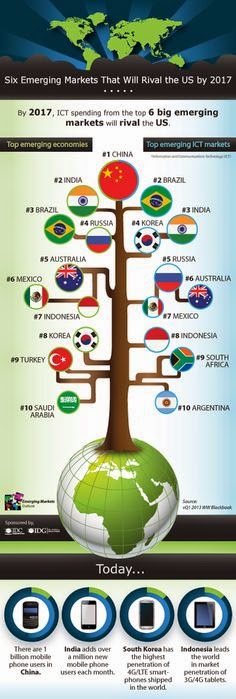
With the Chinese economy on the verge of overtaking America's, the importance of emerging markets, and the changing world order their emergence will create, comes more sharply into focus. As emerging market countries grow their GDP they present investors with opportunities to take advantage of that growth.  

But what exactly defines an emerging market? The term was first used by economists in the 1980's to describe developing economies. A country that's developing has characteristics that include movement towards a free market model, an increasing population of young people, an increasingly sophisticated infrastructure, more political stability (democracy as opposed to dictatorship), and a healthy level of foreign investment.

The four major emerging countries are Brazil, Russia, India and China - known in financial slang as the BRICs. The acronym was first used by Goldman Sachs in a 2003 report. Their belief at the time was that by 2050 these four countries would become wealthier than the current dominant economic powers. The BRICs are followed by the 'Next Eleven', namely Bangladesh, Egypt, Indonesia, Iran, Mexico, Nigeria, Pakistan, Philippines, South Korea, Turkey and Vietnam.

It's worth reflecting for a moment on where we are now in terms of economic supremacy. Western economic dominance came about as a result of the Industrial Revolution, when the means to accelerate production raised output and helped propel  America to where it is today. Before the Industrial Revolution, population tended to be the determining factor in economic performance. What we're seeing now, amply demonstrated by China, is an exercise in industrial catch up. Combine this with an increasingly affluent population of 1.3 billion, which pushes up GDP, and you have the makings of a new economic superpower.

The interesting thing from a potential investor's point of view is that emerging markets are predicted to grow up to 3 times faster than America, according to the International Monetary Fund. Which offers the prospect of good returns. So what are some good solid reasons for including emerging markets in your portfolio?

Diversification: - emerging market countries don't mirror the performance of developed countries, which means they aren't subject to the same downturns. They will have downturns of their own periodically though, so they'll need monitoring.

Predicted growth prospects: - it's estimated that about 70% of global economic growth will come from emerging markets in the near future. India and China are predicted to supply 40% of that growth.

Surplus cash: - most emerging markets have a much better current account surplus than developing economies overall, with China predicted to have a surplus of $450 billion by 2016, as opposed to America's deficit of $643 billion.

Young people: - The workforces of Brazil and India have a high ratio of young people to those retired, which means there'll be plenty of young people supporting the state benefits of their elders. America and the UK by contrast have aging populations, which puts a strain on the welfare system.

Long term performance: - according to Morgan Stanley, who have a number of emerging market indexes, emerging markets have outperformed the developed markets for the last 15 years, a trend that should only continue.

Higher spend: - Consumers in the emerging markets are increasing their disposable incomes and therefore spending more money. The middle class is getting richer. Chinese consumers are prime spenders on luxury goods.

Technology sector: - Social networking is extremely popular in China, with sites like Weibo boasting 130 million active users. There's also Alibaba, which is flourishing and planning an IPO soon. It's the world's largest online marketplace. Russia has search engine Yandex, which now trades on the New York Stock Exchange. These are all money makers.


There are some compelling reasons to feel confident about the continued growth prospects in BRICs and other emerging market countries. Of course this speed of growth brings its own risks, and the amount of exposure to emerging markets in your portfolio should reflect this. Advisers recommend between 5% to 10%.

So, what is the state of, and immediate prospects for the BRICs in May 2014?

Brazil: - will be hosting the world cup this year and the Olympics in 2016, which means it's very busy building the infrastructure to support these. Unemployment rates are low as a resut. However, the forecast for this year sees Brazil's economy slowing, and inflation rising.  Growth is predicted to rise only 2.3%. There have been street protests over the use of public money recently, and President Dilma Roussef is not enjoying a lot of popularity. With some work to do, it seems Brazil won't be contributing greatly to world economic growth this year.

Russia: - the Ukraine crisis and the subsequent sanctions are hurting the Russian economy. The stockmarket and the Rouble have both fallen, and investors have taken around $60 billion out of the country in the last 3 months. In its favour it has plenty of income from gas and oil, and is running a current account surplus. But growth has slowed in the last 18 months, and Russia needs foreign investment, which it isn't getting. If sanctions start to bite things can only get worse. Its poor performance has led some experts to question whether it should be dropped from the BRICs.

India: - the rate of growth in India was down to just under 5% last quarter, down from the high of 9.3% in 2010. The prospects for renewed growth are positive, but a lot will depend on the results of the current election. If Narendra Modi emerges as the victor he is expected to make growth a priority. Economists are expressing optimism for the longer term.

China: - Growth is forecast to continue at about 7.5% this year. This represents a slowdown in recent years, but the government is reportedly happy to go at a slower pace while it introduces reforms like the abolition of the one child policy, and providing better healthcare and affordable housing. The Boston Consulting Group (a leading consultancy) is very bullish on China, and predicts steady growth going forward.

A bit of a mixed report then. Brazil and Russia not looking so healthy, but India and China with cause to be optimistic. It seems that some research is in order before taking the plunge into an emerging markets product. The road to those potentially higher returns could have some volatile ups and downs, but it's a market sector that can't be ignored.

Darren Winters
 
Blogger Templates